Killer Sudoku
Killer Sudoku Zero
Jun 20th
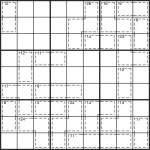
Zero Killer Sudoku 9×9 1 puzzleProbably because it sounded cool, or it was invented by someone who didn’t quite speak English, Killer Sudoku puzzles with some of the redundant clues removed are often referred to as ‘Zero’ Killer Sudoku. Or perhaps it’s because there are “zero redundant clues”. In any case, here’s one of those puzzles, where I have taken out all but the clues you definitely need to get a unique solution.
Usual Killer Sudoku rules apply: Place 1 to 9 in each row, column and bold-lined box as usual, but you must also ensure that each dashed-line cage adds up to the total given at the top-left of it. Numbers can not repeat in a dashed-line cage.
Speaking for myself, I found this puzzle really challenging to solve, but I can promise you that there’s no need to guess or use trial and error in any way – every deduction can be made using standard killer solving techniques.
Good luck! 
Killer Sudoku
Oct 14th
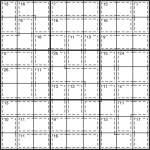
Sudoku Xtra 11 is out now, but I’m holding off the announcement post until it’s available on Amazon.com too. In the mean time, here’s a Killer Sudoku puzzle.
Just place 1 to 9 in each row, column and bold-lined box. Each dashed-line cage should add to the given sum, and you can’t repeat a number in a cage.
Samurai Killer Plus and Minus
May 14th
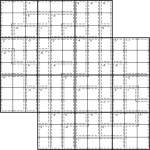
Killer Plus Minus Samurai puzzle
If you’re a Sudoku Xtra reader you’ll have seen these in their regular 9×9 form in both issues 5 and 6, but this is the first time I’ve made a Samurai one, and the first time I’ve posted one here I think.
This is essentially a regular Killer Sudoku puzzle, except that instead of placing 1 to 9 you must place -4, -3, -2, -1, 0, 1, 2, 3 and 4 into each row, column and bold-lined 3×3 box. There are also two overlapping 9×9 grids to solve simultaneously.
As in regular Killer, the values in each dashed-line cage must sum to the given total, and you cannot repeat the same number within any one cage.
Good luck!
Samurai Killer Sudoku Pro 6×6
Apr 27th
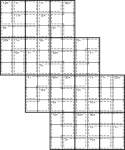
Killer Sudoku Pro 6×6 Samurai puzzle
It’s been quiet here recently – much of my effort has been going on my UK General Election site, How To Vote, although Sudoku Xtra 6 was out on Saturday too. Anyway, there are still 10 days to go to the election but after that I’ll get some time back!
However I thought I should finally post another puzzle – so here one is. Place 1 to 6 in each row, column and 2×3 box (rows and columns are defined by the three underlying 6×6 grids, which you have to infer from the stepping). Also place numbers so that the value at the top-left of each dashed-line cage results from applying the operation between all the value in that cage. For subtraction and division start with the largest value.
Have fun!
Toroidal Killer Toroidal Jigsaw Sudoku
Mar 19th
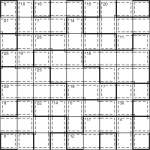
Toroidal Killer Jigsaw Toroidal puzzle
A while back someone asked for some variant toroidal patterns on PuzzleMix, so I was just adding a couple of them to the daily puzzles section when it occurred to me that I could put up a few toroidal killer sudoku too, for a change. However I then realised that the code which creates the HTML will need editing to cope with toroidal regions, but I knew my PDF code was more flexible… and then I thought it would be great to mix this with some toroidal jigsaw regions too… and here’s the somewhat confusing result! A Toroidal Killer with Toroidal Jigsaw regions.
Now if you enjoy this twisted beast let me know, otherwise I probably won’t make any more of them!
Full rules:
- Place 1 to 9 in each row, column and bold-lined jigsaw region
- Place numbers so that the dashed-line cages add to the total given
- No number can repeat in a dashed-line cage.
- Some jigsaw regions and cages ‘wrap around’ the outside the puzzle, continuing at the start/end of the same row/column
Good luck!
Killer Sudoku-X
Mar 4th
I wrote quite a lot yesterday about whether you “needed” the X in some Sudoku-X puzzles. I promised that I’d follow up with the result of analysing a stack of Killer Sudoku-X puzzles, and so here is that result.
I picked 64 Killer Sudoku-X puzzles (52 for the daily puzzlemix section plus 12 for the weekly puzzlemix section), and of those about 5 or 6 (I didn’t write it down…) could be solved via reasonable logical deduction without using the ‘X’ diagonals. So that’s roughly 10% of puzzles, if picked at random, that don’t need it. Quite a bit worse than regular Sudoku-X (see previous post), but nowhere near as high a percentage as I’d expected – I had thought it could be 50% or more, although I should say that this isn’t actually a fair comparison because I disabled the cleverest maths-solving techniques from my analysis software. So in fact this is comparing clever Sudoku-X solving against the same Sudoku-X solving with the addition of relatively less clever Killer Sudoku-X solving, so perhaps this biased the result much more to the non-Killer result (from yesterday) than it should have done. But anyway, I’m not writing a scientific paper and it’s good enough for me!
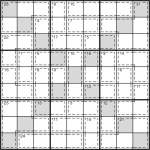
Killer Sudoku-X puzzleSo the result of all this is pretty simple: the Killer Sudoku-X on PuzzleMix for the coming year should be better than ever! You should need that X every time…
PS Enjoy the Killer Sudoku-X I’ve attached here! Just place 1 to 9 in each row, column, 3×3 box and main diagonal, plus make sure the cages add to the given amounts – and don’t repeat a number in a cage.
Jigsaw Killer Sudoku
Mar 2nd
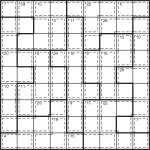
I’ve recently been working on refreshing the content for PuzzleMix.com, my play-online puzzle site, and one of the puzzle types I’ve been making is Killer Jigsaw Sudoku, where you not only have the jigsaw-shaped Killer regions but also jigsaw shapes instead of the regular 3×3 Sudoku boxes.
So I thought it would be a good idea to post one of these puzzles here – they can be quite tricky, at least until you get your head around the difference between these and regular Killer!
The rules are simple:
- Place 1 to 9 in each row, column and bold-lined region
- Place numbers in the dashed-line cages that add up to the given total for that cage
- No number can be repeated in a dashed-line cage
Good luck!
Double Toroidal Killer Sudoku Pro 8×8
May 13th
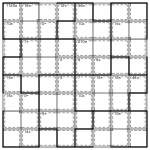
Double Toroidal Killer Sudoku Pro 8×8 puzzle
This puzzle certainly won’t be to everyone’s tastes, but it’s a double toroidal killer sudoku pro. Why double? Because there are toroidal jigsaw-shaped Sudoku regions, and there are toroidal jigsaw-shaped Killer Sudoku Pro cages. In other words, some of them wrap around the edges of the puzzle. It’s also an 8×8 puzzle, just to keep the Killer Sudoku (Pro!) logic fresh.
The rules are as you might expect:
- Place 1 to 8 into each row, column and bold-lined shape – some of these shapes are toroidal, so wrap from the end of one row/column to the opposite end of the same row/column
- Place numbers into the dashed-line Killer Sudoku Pro cages so that when the given operation is applied the result is the stated number. For ‘-’ operations start with the highest number.
- Numbers can’t repeat in dashed-line cages, and some cages (just one in this puzzle actually) are toroidal, so wrap around the rows/columns as described above
And that’s it! Good luck!
Hints: As always with this sort of puzzle, if you shade in the 8 bold-lined regions first with different colours you’ll find it much easier to keep track of what you’re doing. Also, all of the regions (both killer cages and bold-lined regions) have rotational symmetry order 4 – in other words, the same pattern repeats 4 times; this might help!
Toroidal Killer Sudoku 10×10
May 12th
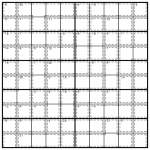
Toroidal Killer Sudoku 10×10 puzzle
So far all of the “pure Sudoku logic” in my puzzles posted here has been pretty gentle. Well I decided that it was time to change that, but of course I wasn’t about to do that with a common garden puzzle! So I’ve applied some harder logic to this 10×10 Killer Sudoku with toroidal cages.
Because this is a 10×10 puzzle I’ve kept the Killer Sudoku part very easy – there are plenty of single cages (with apologies to those who dislike these!) and although the maths goes a tiny bit higher the actual ‘Killer reasoning’ is straightforward. But the Sudoku reasoning itself is definitely tougher, in places.
So here are the rules:
- Place 1 to 10 into each row, column and bold-lined 5×2 cage
- Place numbers so that they add up to the total at the top-left of each dashed-line cage
- Numbers may not repeat within a dashed-line cage
- Some cages wrap around the edges of the puzzle – they continue in the same row/column on the opposite side of the puzzle (so a cage leaving off the right of row 3 continues on the left edge of row 3, and vice-versa)
In summary, then, there are a few relatively unusual things here: the 1-10 Killer sums and 1-10 Sudoku; the toroidal cages; and the fact that this Killer requires tough Sudoku logic and so plays more like a 1-10 regular Sudoku than a 1-10 Killer… once you get going, that is!
Good luck!
Samurai Toroidal Killer Sudoku Pro 13-grid
May 7th
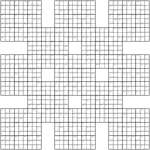
Samurai Toroidal 13-grid Killer Sudoku Pro puzzle
Now this is a puzzle I can state with confidence that you won’t have seen before. It’s a Killer Sudoku Pro puzzle – i.e. a Killer Sudoku with -, x and / regions too; but more than that it’s a Samurai Killer Sudoku Pro made out of 13 grids; and then further still the cages are toroidal, both around the edge of the grid and across the gaps. In other words, the Killer Sudoku Pro regions aren’t bounded by the actual physical layout of the 13-grids – they either jump the gap (in a straight line) or wrap around the edges of the puzzle (again in a straight line, albeit one that jumps to the other side!).
If you like huge puzzles then you should really enjoy this, assuming you can print it out large enough to actually have a chance of solving it! For everyone else, I’ll post some more smaller puzzles soon! It’s not actually very difficult, logically, but completing the whole thing would still take a fair while – perhaps a couple of hours, I think.
The rules are:
- Place 1-9 into each row, column and 3×3 bold-lined box of each of the 13 underlying 9×9 Sudoku grids
- Place numbers into each dashed-line cage so that all together they give the total at the top-left of the cage once the given operation is applied – for subtraction and division start with the largest number in the cage and then subtract/divide-by the other numbers.
- Numbers can not be repeated in a cage.
- Some cages continue across the gaps – just use an imaginary straight-line rule to follow them on and find the rest of the cage (so for example if a cage runs across a gap in the 3rd row down, it continues on the other side of the gap also on the 3rd row down)
- Some cages continue across the edges of the grid – these wrap around to the same row or column on the opposite side of the puzzle
If you try it: Good Luck!


Recent Comments