DrGarethMoore.com
Mar 11th
I haven’t used this site for several years. Please visit:
DrGarethMoore.com
for up to date content. Thanks! 
404: Interactive Puzzle Book
Feb 12th
My brand new puzzle book is now live on Kickstarter!
Solve the puzzles and reveal the conspiracy. If you enjoy riddles, brainteasers or escape room games, 404 is for you.
This project is dependent on it reaching a certain level of funding, so do please come along and back us – and use the social media links on the Kickstarter page to share it with your friends. Thank you so much!
Daily Mail Weekend Magazine
Mar 4th
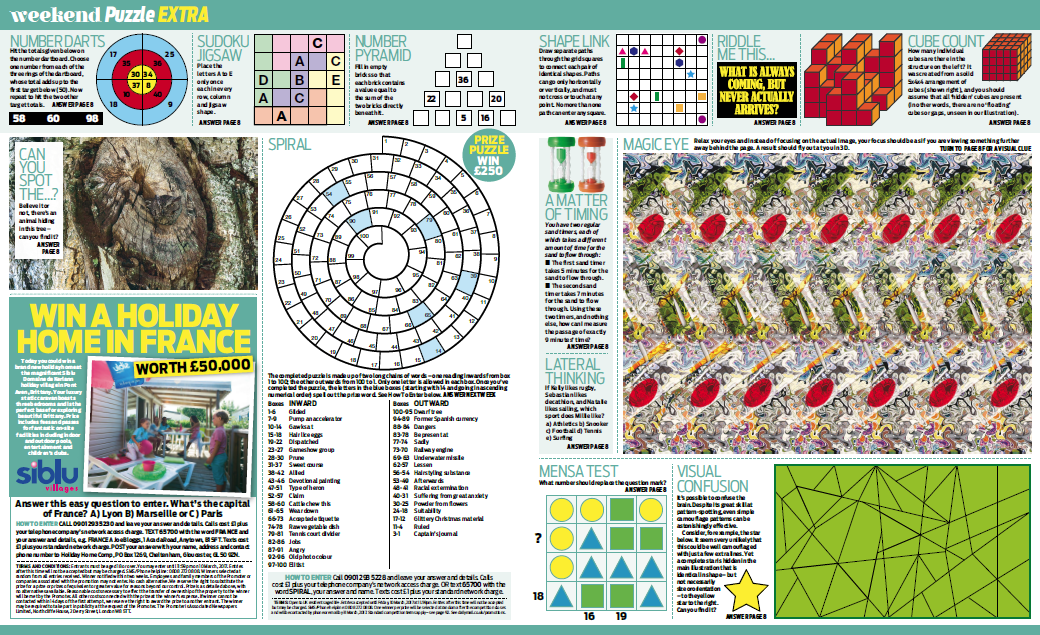
Weekend magazine Daily Express 4th March 2017
This weekend’s Weekend magazine in the Daily Mail features 8 pages of my puzzles, including some that you won’t find anywhere else.
Puzzles include:
- Prize spiral crossword – the clues read both inwards and outwards!
- Wolves and Sheep – a variant on Slitherlink where you have to keep the sheep from the wolves
- Letter soup – anagram mix
- Shape link – a colourful version of number link
- Sudoku Jigsaw – 5×5 puzzle
- Bridge Maze – complex multi-level maze
- Masyu – find a loop through the circles
- Cell blocks – a small Rectangles, but with symmetric, attractively arranged givens
- Futoshiki – inequality latin square
- King’s Journey – find a route that visits every square once
- Griddler – a 15×15 Hanjie picture-revealing puzzle
- Giant dot-to-dot – in colour!
- And many more, including word search, cube counting, shape division, ‘what connects?’, missing letters, matchstick, riddles, spot the difference, optical illusion, dis-em-vowelled, number pyramid, number darts, visual confusion, lateral thinking, logic puzzles – and more!
And what’s more, there are 4 more pages of my puzzles every single day this week in the Daily Mail, in addition to the paper’s regular puzzle content, and that selection will include some of the same plus some original puzzles such as a star-shaped 3D Sudoku. There is also a prize spiral crossword every day, so get your pencils ready!
April 1st Sudoku
Apr 1st
Wow, it is a long time since I posted here. So much to do, so little time!
I might as well keep it brief now, then. Here’s a puzzle for April 1st (it’s actually a normal puzzle without tricks – it just spells ‘FOOL’ in the given numbers). Place 1 to 9 in each row, column and bold-lined box.
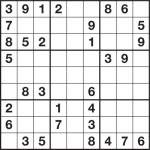
Sudoku April 1st puzzleWow, it is a long time since I posted here. So much to do, so little time!
I guess that means I might as well keep it brief now, then. On that basis:
Here’s a puzzle for April 1st. It’s actually a normal puzzle without tricks – it just spells ‘FOOL’ in the given numbers. Like any Sudoku, simply place 1 to 9 in each row, column and bold-lined box.
Box-Jigsaw Sudoku
Aug 5th
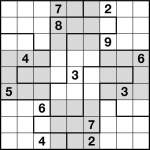
Sudoku Box-Jigsaw 9×9 1 puzzleI haven’t posted a puzzle for a good while, so I thought it was time to fix that with this Box-Jigsaw Sudoku puzzle.
The puzzle combines regular Sudoku with Jigsaw Sudoku. Just place 1 to 9 once each into all of the nine rows, columns, 3×3 boxes (indicated by both shaded and unshaded background areas) and bold-lined jigsaw regions.
New 3D Sudoku book
Jun 2nd
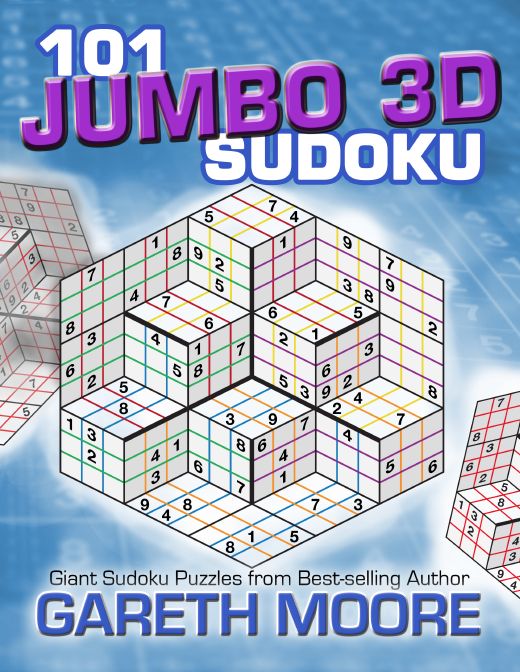 A brand new book, packed with 101 Jumbo 3D Sudoku, is now available for purchase from Amazon. You can either search for this directly, or you can click through via my PuzzleBooks.org site – the book is at the very bottom of that page, and clicking on it will take you direct to the correct page on your nearest Amazon store.
If you’re not sure of the rules, or haven’t seen one of these puzzles before, then check out the example puzzle I posted last week.
Jumbo 3D Sudoku
May 19th
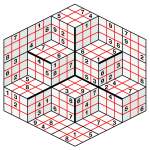
Jumbo 3D sudoku puzzleI haven’t posted for a while so I thought I should post one of my new puzzles. This one is a Jumbo 3D Sudoku, where the aim is simply to place 1 to 9 into each black-lined 3×3 area as well as each of the 54 rows indicated by the coloured lines. Thick black lines indicate borders where the rows don’t continue.
There’ve been 3D sudoku around for a while, and in terms of solving there’s little difference from regular sudoku except for the increase in size and the way in which the bendy regions can easily cause you to miss an “obvious” deduction! This is the biggest I’ve seen, but it’s perfectly possible there are larger ones I’m not aware of.
Anyway, if you’re a fan of samurai sudoku or any other kind of large sudoku then you should enjoy this, I hope!
Average solving time is around 1 hour.
Product Killer Sudoku
Mar 21st
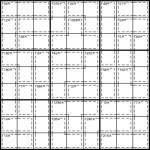
Product Killer Sudoku 9×9 puzzle
If you’re interested in sudoku, come along to the official UK sudoku championship next weekend, the 29th-30th of March, at Selsdon Park Hotel just south of London, outside Croydon. There’s full details on the UK Puzzle Association site. There’s still spaces available.
Mind you, it’s not just sudoku – there’s also the UK puzzle championship taking place the same weekend, and there’s a low price which includes overnight accommodation and most meals for those who take part. Winners of both events get the chance to represent the UK in the World Puzzle Championships and World Sudoku Championships.
One of the puzzles in the sudoku part of the tournament is Product Killer Sudoku, a variant on Killer Sudoku where multiplication, rather than addition, is used.
So: just place 1 to 9 once each into every row, column and bold-lined box. Also place numbers in each dash-lined cage so they multiply to the given total. You also can’t repeat a number within a dashed-line cage.
Valentine Sudoku
Feb 14th
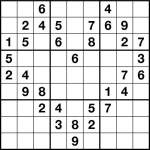
Valentine SudokuA quick heart-shaped sudoku for Valentine’s Day. Just place 1 to 9 once each in every row, column and bold-lined box.
Brained Up – online daily brain training
Feb 9th
 I’m incredibly excited to announce Brained Up, a cutting-edge brain training site that will help you do just that – upgrade your brain! It’s based around daily online sessions that each provide a wide-ranging mental workout. The site launched just before Christmas, and already has a healthy number of daily users.
Just a few minutes a day is all it takes to upgrade your brain. Visit Brained Up and receive a personalized training plan, optimized to get the best out of your body’s most important organ. Your personal schedule will include a wide range of brain games, ensuring full coverage of key mental skills.
Studies have shown that suitable brain training activity can make you quicker and smarter. This can lead to improved creative, conversational and social skills.
Brained Up features scientifically designed exercises based on extensive research to ensure comprehensive coverage of key cognitive skills, including creativity.
Using Brained Up, just a few minutes a day is all it takes to upgrade your brain. The site constructs a personalized training plan for every user, optimized to get the best out of your body’s most important organ. Every schedule includes a wide range of brain games, ensuring full coverage of key mental skills – as well as keeping it fun throughout.
Studies have shown that suitable brain training activity can make you quicker and smarter, which can lead to improved creative, conversational and social skills. Brained Up therefore features scientifically designed exercises, based on extensive research, to help ensure comprehensive coverage of key cognitive skills, including creativity.
It’s at www.BrainedUp.com.


Recent Comments