about 11 years ago - Comments Off
Wow, it is a long time since I posted here. So much to do, so little time!
I might as well keep it brief now, then. Here’s a puzzle for April 1st (it’s actually a normal puzzle without tricks – it just spells ‘FOOL’ in the given numbers). Place 1 to 9 in each row, column More >
about 12 years ago - Comments Off
Sudoku Box-Jigsaw 9×9 1 puzzleI haven’t posted a puzzle for a good while, so I thought it was time to fix that with this Box-Jigsaw Sudoku puzzle.
The puzzle combines regular Sudoku with Jigsaw Sudoku. Just place 1 to 9 once each into all of the nine rows, columns, 3×3 boxes (indicated by both shaded and More >
about 12 years ago - Comments Off
A brand new book, packed with 101 Jumbo 3D Sudoku, is now available for purchase from Amazon. You can either search for this directly, or you can click through via my PuzzleBooks.org site – the book is at the very bottom of that page, and clicking on it will take you direct to the correct More >
about 12 years ago - Comments Off
Jumbo 3D sudoku puzzleI haven’t posted for a while so I thought I should post one of my new puzzles. This one is a Jumbo 3D Sudoku, where the aim is simply to place 1 to 9 into each black-lined 3×3 area as well as each of the 54 rows indicated by the coloured lines. More >
about 12 years ago - Comments Off
Valentine SudokuA quick heart-shaped sudoku for Valentine’s Day. Just place 1 to 9 once each in every row, column and bold-lined box.
about 12 years ago - Comments Off
Sudoku Xtra 24 is now finally available! It’s packed with 130 puzzles of a wide range of types, including a huge variety of sudoku variants.
This issue I’ve included a very wide range
of variants, including some new ones such as Two-grid Interconnected Sudoku, Mystery Multiple
Sudoku and Blackout Sudoku. Meanwhile I’ve made an effort to include More >
about 12 years ago - Comments Off
Sudoku Christmas Star puzzleA Sudoku, in a star shape.
Just that. (Place 1-9 once each into every row, column and bold-lined 3×3 box).
about 13 years ago - Comments Off
I’ve recently launched a new series of ‘101 Giant Sudoku’ books, to cater for those who like their Sudoku to be considerably larger than normal!
You can see the entire series at PuzzleBooks.org (scroll to the bottom) or visit Amazon and search for “101 giant sudoku”.
There are currently 12 books in the series: 14×14, 15×15, 16×16, 18×18, More >
about 13 years ago - Comments Off
Just a quick heads-up that PuzzleMix, my site where you can play a wide range of puzzles online, now supports touch screen play for all of the number entry puzzles – so that’s Sudoku, Killer Sudoku, Futoshiki, Calcudoku, Skyscraper, Sudoku X, Kropki Sudoku, Killer Sudoku Pro, Jigsaw Sudoku, Consecutive Sudoku, Wraparound Sudoku, Sudoku XV, Killer More >
about 14 years ago - 1 comment
Little-Killer Sudoku 9×9 1 puzzleIn Little-Killer Sudoku the total of each of the diagonals in the grid, other than those 9 cells long, is given. Each number has an arrow next to it which points to the diagonal it gives the sum of, so therefore the top-left cell in this grid must be a 9 More >



about 17 years ago
Yum Yum Fun!
*****
SPOILER!
*****
I am not sure what nasty hidden set you were referring to. At the start of the puzzle I worked on the center box and very lower box. Then I did the conga line of consecutives in the middle right row.
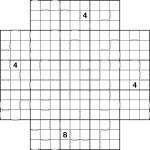
Once you do this and apply the samurai flower rule diligently, the puzzle breaks down rather nicely. I think there were a few times I had triplets with a pair of consecutive numbers with no bars in the row/column … which meant the non-consecutive number had to be in the middle square.
I enjoyed this one. Thanks.
about 17 years ago
Ah, now that’s a good point – I’d overlooked that! I ran my sudoku analysis software on it but it doesn’t look at multiple groupings of consecutive markers in the same region, considering only any chosen pair at once. If you don’t look at region cooccurrences then you need a hidden quad towards the end, but of course any human solver would make the more intuitive deduction instead.
You can see a similar issue in Futoshiki if a computer solver considers only pairs (the obvious way to implement). If a>b<c in a single row/column then in (say) a 5×5 grid clearly b cannot be 4, but if you consider only pairs then the only deduction the computer will make is that b is not 5 (without any other information at any rate). Whilst it’s not hard to make a machine more intelligent (it can easily run an exhaustive search) the problem soon becomes that you make puzzles that are far too hard – so I’ve always thought it better to err on the side of too easy than too hard! Of course, if you have the time and inclination then the best solution of all is to make explicit implementations of all the things you find yourself doing as a human solver – then you can be sure it’s fair and tricky!
about 17 years ago
This was a great puzzle – just the right degree of difficulty for me – challenging but manageable. As you probably know by now, I don’t do the sudoku solving jargon (I’ve never got to grips with it, though I’m sure I use some of the strategies without realising it). Just to say that once started I managed this without too much difficulty. Like Spittledung I started with the lower centre box, and then looked at the very long line of consecutive numbers in the middle, and with some thought the puzzle seemed to fall into place. It took me about an hour to complete.
Now to get back to the 12 x 12 one – I’m not getting anywhere fast with that. I may be asking for a few hints soon!