about 11 years ago - Comments Off
Wow, it is a long time since I posted here. So much to do, so little time!
I might as well keep it brief now, then. Here’s a puzzle for April 1st (it’s actually a normal puzzle without tricks – it just spells ‘FOOL’ in the given numbers). Place 1 to 9 in each row, column More >
about 12 years ago - Comments Off
Sudoku Box-Jigsaw 9×9 1 puzzleI haven’t posted a puzzle for a good while, so I thought it was time to fix that with this Box-Jigsaw Sudoku puzzle.
The puzzle combines regular Sudoku with Jigsaw Sudoku. Just place 1 to 9 once each into all of the nine rows, columns, 3×3 boxes (indicated by both shaded and More >
about 12 years ago - Comments Off
A brand new book, packed with 101 Jumbo 3D Sudoku, is now available for purchase from Amazon. You can either search for this directly, or you can click through via my PuzzleBooks.org site – the book is at the very bottom of that page, and clicking on it will take you direct to the correct More >
about 12 years ago - Comments Off
Jumbo 3D sudoku puzzleI haven’t posted for a while so I thought I should post one of my new puzzles. This one is a Jumbo 3D Sudoku, where the aim is simply to place 1 to 9 into each black-lined 3×3 area as well as each of the 54 rows indicated by the coloured lines. More >
about 12 years ago - Comments Off
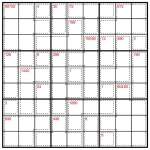
Product Killer Sudoku 9×9 puzzle
If you’re interested in sudoku, come along to the official UK sudoku championship next weekend, the 29th-30th of March, at Selsdon Park Hotel just south of London, outside Croydon. There’s full details on the UK Puzzle Association site. There’s still spaces available.
Mind you, it’s not just sudoku – there’s also the More >
about 12 years ago - Comments Off
Valentine SudokuA quick heart-shaped sudoku for Valentine’s Day. Just place 1 to 9 once each in every row, column and bold-lined box.
about 12 years ago - Comments Off
Sudoku Xtra 24 is now finally available! It’s packed with 130 puzzles of a wide range of types, including a huge variety of sudoku variants.
This issue I’ve included a very wide range
of variants, including some new ones such as Two-grid Interconnected Sudoku, Mystery Multiple
Sudoku and Blackout Sudoku. Meanwhile I’ve made an effort to include More >
about 12 years ago - Comments Off
Sudoku Christmas Star puzzleA Sudoku, in a star shape.
Just that. (Place 1-9 once each into every row, column and bold-lined 3×3 box).
about 13 years ago - Comments Off
I’ve recently launched a new series of ‘101 Giant Sudoku’ books, to cater for those who like their Sudoku to be considerably larger than normal!
You can see the entire series at PuzzleBooks.org (scroll to the bottom) or visit Amazon and search for “101 giant sudoku”.
There are currently 12 books in the series: 14×14, 15×15, 16×16, 18×18, More >
about 14 years ago - Comments Off
Just a quick heads-up that PuzzleMix, my site where you can play a wide range of puzzles online, now supports touch screen play for all of the number entry puzzles – so that’s Sudoku, Killer Sudoku, Futoshiki, Calcudoku, Skyscraper, Sudoku X, Kropki Sudoku, Killer Sudoku Pro, Jigsaw Sudoku, Consecutive Sudoku, Wraparound Sudoku, Sudoku XV, Killer More >


about 17 years ago
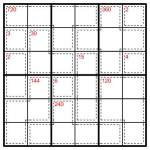
At first sight, these seemed to be the same as Kenken puzzles, but having re-read the rules it’s an interesting twist to note that you can’t repeat digits within the cages as you can with Kenken. Makes them slightly easier as a few more options are eliminated. I see what you mean about not having to do the large multiplications – thank goodness!
about 17 years ago
I’m going to clarify the different type of puzzles in my next blog post, which will appear at midnight (GMT) I think – I’ve decided that we can break the Killer Sudoku / KenKen(TM) space down into four different puzzle types.
about 17 years ago
It is different. I really like Killer Sudoku. I didn’t have to do huge multiplication except to check my work. I came away with the rules of Multiples and Integer Division to speed things up.
Multiples being where if the answer is 12 in 2, then the cage can have the digits: 2,3,4,6.
Integer Division is to divide the answer by a potential number in the cage. If you get a remainder, the divisor digit is NOT in the cage. If you do this for known numbers in the cage, the result is now a smaller number for the remaining digits and it gets easier.
After doing more of these, I can get to the point where looking at a value of some of the cages can auto-tell me the digits in the cage (just as for kakuro, 23 in 3 is 6-8-9).